
Rick Ducat
Chartered Market TechnicianDefense Sector Whipsawed as President Trump Floats 50% Military Budget Increase
Rick Ducat
Chartered Market TechnicianDefense sector traders faced a whipsaw day after President Trump roiled markets, first blasting excessive executive pay and pledging to block major companies’ dividends and stock buybacks until they ramp up production but then later the same day saying he wanted to hike U.S. military spending by $50% to $1.5 trillion.
This resulted in rapid-fire swings and reversals in names like Lockheed Martin (LMT), Northrop Grumman (NOC), and RTX (RTX). Lockheed Martin, for example, fell about 7% from its intraday highs before the president’s comments to close at 496.87, but then rocketed right back up above those initial highs and now stands to open near about 536 based on early trading.
This seems to display a sign of political risk in the current trading environment. Political risk has commonly impacted the stock market throughout its history and refers risks posed by legislative and domestic policy changes that could have sweeping effects on individual companies or even whole sectors.
Recent examples include the tariff news announcement shock and stock plunge in April followed by the scorching hot rally right after – but also remember situations such as the end of electric vehicle credits for a company like Tesla (TSLA).
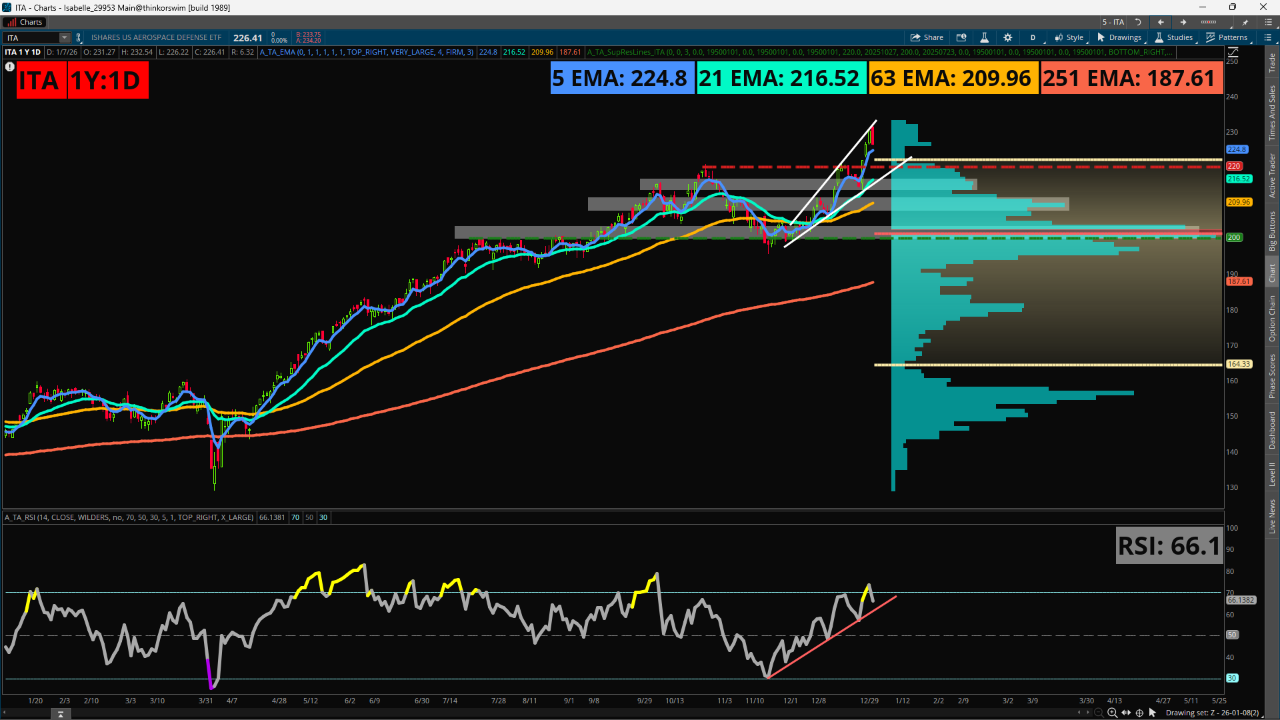
Traders could follow the defense sector by examining the iShares U.S. Aerospace & Defense ETF (ITA), which hit all-time highs of 232.54 shortly before President Trump’s comments. A technical look at this product shows that it yesterday formed a bearish engulfing candle; however, ITA now stands poised to open at fresh all-time highs near 234, so it is questionable whether that bearish pattern will get its needed confirmation of a second day of declines. The Relative Strength Index also remained high despite slipping below the overbought area, closing at about 66.
Downside support could be found near 220, as it represents the old highs from late October and a more recent resistance area from late December. A bit further down near 215 shows the confluence of the 21-day Exponential Moving Average, a trendline beginning with the November lows near 200 (another key supportive area), and a smaller volume node. Options markets show a potential expected move of about +/- 3.4% for the Jan. 16 expiration and of around +/- 6.2% for the Feb. 20 monthly. The lower edge of the Feb. expiration lines up close with the 220 support, while the upper edge near 247 is roughly the +1 yearly Standard Deviation Channel.
Featured Clips