
Kevin Green
Sr. Markets CorrespondentThe Rolling Market Correction
Kevin Green
Sr. Markets CorrespondentMarkets staged a sharp bounce on Friday after enduring selling pressure for most of the week. From a technical standpoint, a rebound appeared likely—which we will discuss—but the bigger picture suggests that a significant amount of “froth,” or underlying damage, has already been removed from the market, even though the major indexes remain relatively close to all-time highs. The “rotation” trade has been in effect for the past two months, but we have now entered what can be described as the rolling market correction phase.
This term reflects the fact that money has been rotating out of speculative technology stocks and high-beta themes in general, from small modular nuclear reactor companies to silver, and many of these areas have corrected considerably beneath the surface. This has not been a run-of-the-mill rotation, and that’s healthy. Sectors such as Consumer Staples, Industrials, and Materials have not participated as strongly in the A.I. rally over the last three years, as capital flows have been heavily concentrated in a narrow group of mega-cap tech names, pushing those asset values higher. These three sectors, however, carry relatively small weightings in the S&P 500. Combined, they account for only about 15% of the index. Even if we add Energy, which represents roughly 3% and has traded more on geopolitical risk than on underlying fundamentals, the overall impact on the S&P 500 remains limited.
When rotation trades occur and institutional investors seek lower-beta (lower-volatility) sectors to reduce risk, it doesn’t take much capital to move these sectors—and that is exactly what we are witnessing right now. Now let’s talk about this stealth “correction.”
Although the “Mag 7” stocks—Apple (AAPL), Microsoft (MSFT), Amazon (AMZN), Meta Platforms (META), Nvidia (NVDA), Alphabet (GOOGL), and Tesla (TSLA)—capture most of the daily attention, and rightfully so given their massive influence on the S&P 500, they have not been trading particularly well. Meta, Microsoft, and Amazon are all trading below their 200-day simple moving averages, while Tesla and Nvidia came within 1.5% of that level on Thursday. Nvidia, Tesla, Meta, Amazon, and Microsoft have all corrected at least 10% from their all-time highs. Software stocks, as measured by the iShares Software ETF (IGV), are down more than 30% from their 2025 highs and are now trading near the “tariff tantrum” lows.
Stocks tied to the popular nuclear power theme have also been hit hard, with most down at least 30% from their 2025 highs. Oklo (OKLO) and NuScale Power (SMR) are more than 60% below their all-time highs. Other names have suffered as well. IREN Ltd. (IREN) is down 40% from its peak, even after an 8% bounce on Friday, while Fluence Energy (FLNC) has fallen roughly 40% from its highs. The reason I highlight all of this is simple: a great deal of damage has already occurred. Can it get worse? Of course. But even a rotation out of the recently outperforming sectors, such as Consumer Staples and Materials, would likely have only a modest impact on a broad, market-weighted index like the S&P 500.
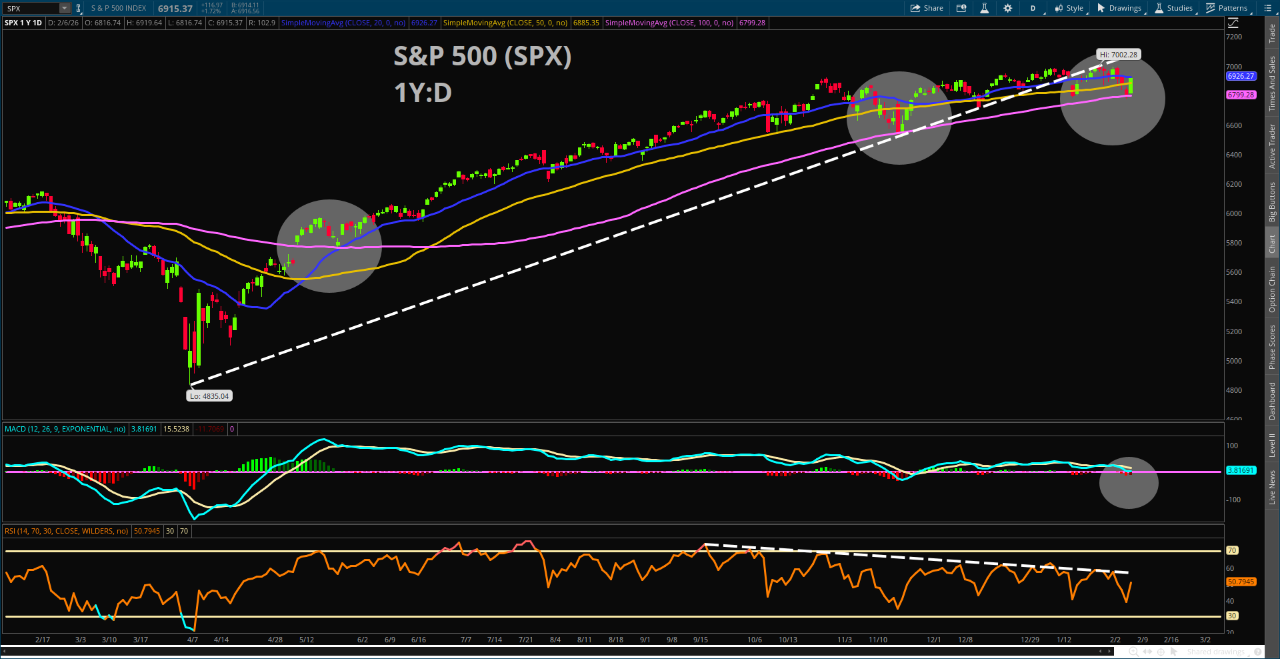
From a technical standpoint, the S&P 500 came down and tested the 100-day Simple Moving Average on Thursday. During the last three times this moving average was tested, the market traded higher the next day. Friday another bounce off of this moving average occurred. The aggressive buying action may be short covering in nature or possibly new longs entering the market. The change in Open Interest for the E-mini S&P 500 futures (/ES) will give more insight into that as the data is updated over the weekend.
For now, we appear to be seeing consolidation through time rather than price, and the seasonal weakness in February is arriving right on schedule. Volatility in the U.S. dollar has stabilized for now, the 10-year Treasury yield has rejected the 4.30% level for the moment, and the bulk of earnings season is behind us. The market is attempting to digest increased capital expenditure spending from the Hyperscalers as best it can. Concerns around software remain, but the narrative that A.I. will immediately take significant market share is likely a multi-year story, not something that plays out in a week or two.
Importantly, last week’s pullback has been orderly. Credit markets, as reflected by high-yield spreads, have seen only a modest uptick, and that move is coming from historically low levels. The primary risk to the market over the next two weeks will center on economic data, which tends to be volatile and seasonally weak in January and February. That environment can push volatility and credit spreads higher. Still, so far, the market pullback has been orderly.
Featured Clips