Maria Schrater
WriterBullish (BLSH) CEO on Expansion Plans and Crypto Options Trading
Maria Schrater
WriterBullish (BLSH) is an international crypto trading exchange, boasting low fees and high efficiency. In the U.S., they only offer spot trading, which they launched in September. In 3Q, they surpassed $1 billion in options trading volume. CEO Tom Farley joined Morning Movers to discuss their record 3Q and expansion plans.
Exchanges and brokers typically make money from fees on both sides of the trade: the buyer and seller. Retail trading fees dropped during the last few years, and it is now basically industry standard to offer zero-fee trading. Bullish offers “no maker fees and low taker fees” for institutional accounts and 0% trading fees for individual accounts. However, the company also makes money on spreads and has diversified its revenue streams to include subscriptions, services, interest on lending arrangements and their own cash/stablecoin holdings, and more.
Crypto networks, like regular financial markets, have fees that can take many forms. One of these is called “gas,” a mutable transaction cost paid to network validators.
Validation is a key component of the crypto ecosystem that is one of the backbones of its status as purely digital currency. Basically, multiple computers “check the work” of a transaction before it’s permanently recorded on the blockchain, and the computing power used is paid for with gas. That’s why gas fees can spike during periods of heavy activity: the network making up the blockchain has a lot of demand. Ethereum, for example, is a blockchain known for higher gas fees.
Bullish partially gets around this with its stablecoin offerings through smart contract optimization and other strategies. The lower fees could be attractive to customers, especially because these transaction fees can vary so widely. It also gives traders easier access to converting cryptocurrencies and trading a wider variety of financial instruments within the crypto world.
The company also operates CoinDesk, “the number one media business in crypto,” providing data and information to crypto traders.
Despite crypto’s rough last few months, trading volumes and investor interest continue to rise. Bullish said it signed multiple institutional partners in 3Q, and reported November trading volume alone hit $80.8 billion, the majority of that being Bitcoin ($18.4 billion).
Bullish is all-in on crypto: it took its IPO profits – around $1.15 billion – in stablecoins, mostly minted on the Solana network. Stablecoins are designed to avoid the volatility that plagues crypto assets, often by being pegged 1:1 to the U.S. dollar and using smart contracts to respond to supply/demand imbalances to maintain that ratio. JPMorgan estimates this market is around $225 billion, and about 7% of the crypto ecosystem overall.
Bitcoin, which is now down -4% year-to-date and -8% vs last year, is well below the $100K level traders were excited about. The cryptocurrency has tended to hit outsized booms and busts throughout its existence, since it responds dramatically to sentiment. There’s no clear main factor for the drop; things are looking up for the crypto industry overall with the GENIUS Act, CLARITY Act, and U.S. government interest.
Farley expects continued crypto innovation, explaining it was mostly spot trading, aka “instantaneous” trading, in the early stages. He thinks options are the biggest growth opportunity, contrasting them to the “reckless policies” of perpetual futures trading. “We jumped in with both feet, and it’s going very well.”
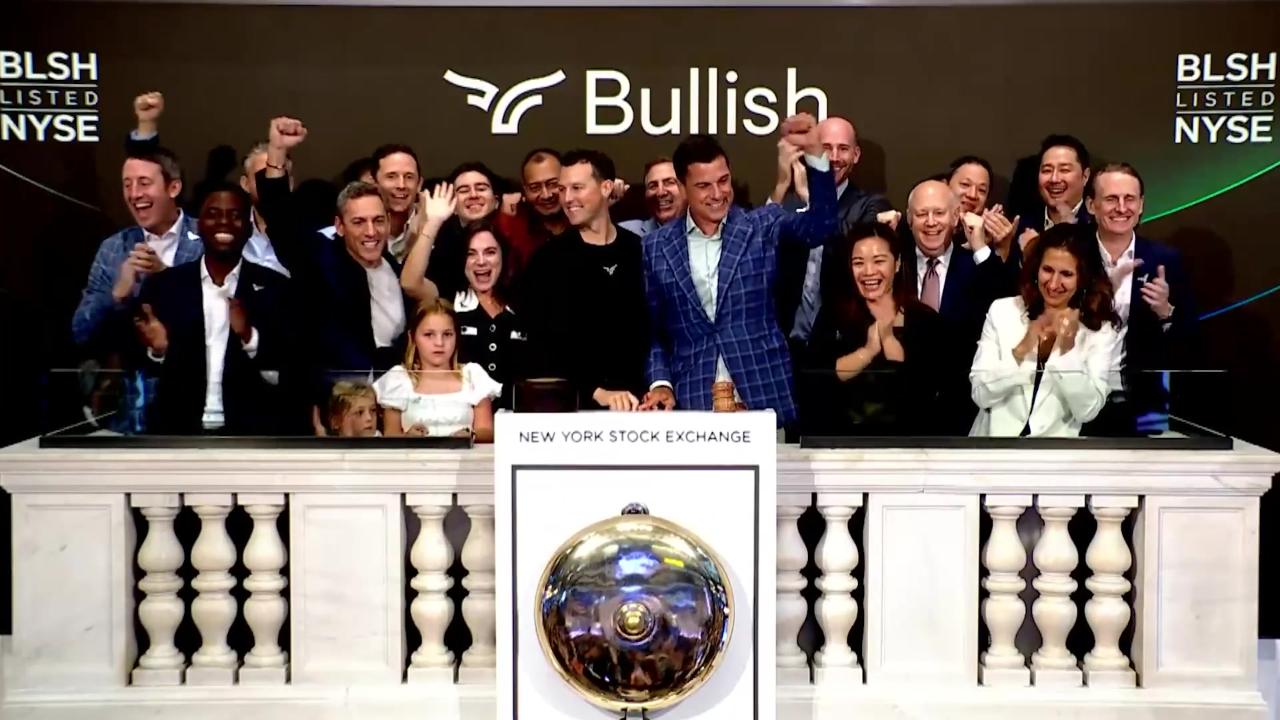
As a former chair of the NYSE, Farley also believes that the institution is also headed “on-chain” eventually. He reminisces about Bullish’s recent IPO and the “tidal wave” he expects to remake the nature of financial exchanges.
Watch the full interview here:
Featured Clips